
How the translation industry has changed since 2019: a child’s perspective
A time capsule of the language industry in 2019
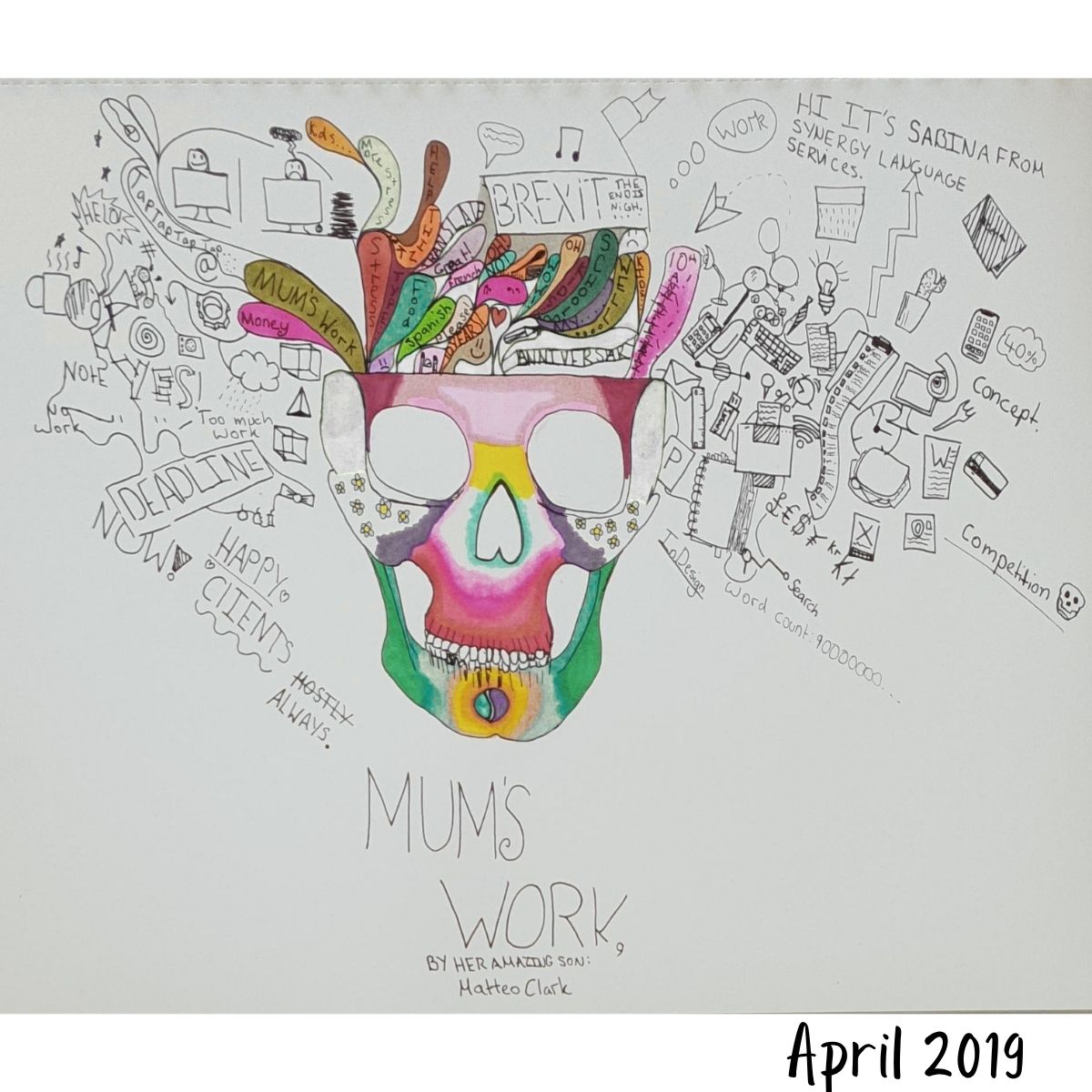
Recently, I rediscovered a drawing my son created in April 2019 when he was just 11 years old. He called it Mum’s Work.
At first glance, it’s a colourful and imaginative piece of art. Looking more closely, however, it feels like a time capsule of the language industry and the way we worked just seven years ago.
The drawing is packed with details he associated with my job and, of course, Brexit takes centre stage (I must have spoken about it quite a lot!). There are sketches of notebooks and planners, references to phone calls and emails, and a constant stream of tasks competing for attention.
How the translation industry has changed
Looking at the drawing today, I wonder how it would appear if he drew it again. The landscape has certainly changed dramatically. How much of the picture would be positive messaging, and how much would be negative?
Artificial intelligence would almost certainly feature prominently. So would automation, machine translation, large language models, collaboration platforms, and the increasingly global nature of communication.
The tools we use have evolved, and many routine processes have become faster and more efficient than we could have imagined in 2019.
What hasn’t changed in language services?
Yet perhaps the most interesting question is not what has changed, but what has stayed the same.
Behind every translation project is still a need to communicate clearly, connect cultures, and help organisations reach people in their own language. Technology continues to transform our industry, but the human purpose behind it should remain unchanged.
But will it remain the same?
The human element in an AI-driven world
People’s expectations are evolving alongside advances in technology, and this is something that affects not only the translation industry but every aspect of modern life.
As AI becomes increasingly integrated into the way we work, communicate, and consume information, it is worth asking whether our expectations of quality, speed, accuracy, and human interaction are changing too.
Looking ahead
My son’s drawing captured a moment in the evolution of the language industry. Looking at it now makes me shed a little tear but also reminds me just how far we’ve come and how important it is to keep the human element at the centre of everything we do.
The tools may change, but the need to understand one another remains as important as ever.

